
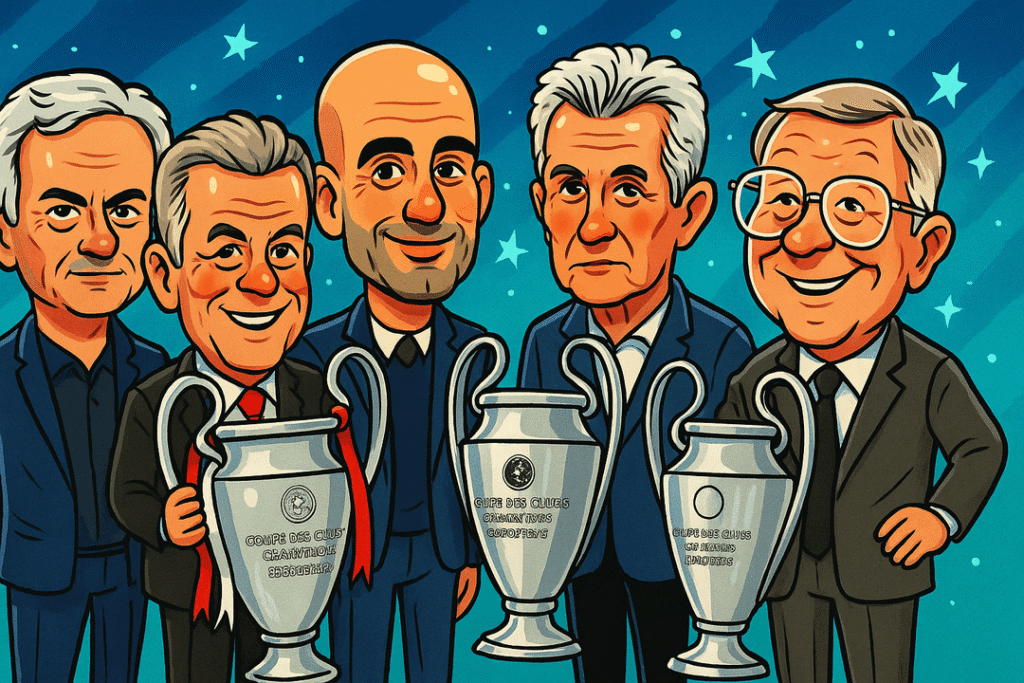
So, in this Footballing article you are going to get info on some of the best Footballing managers of all time. The Managers who have lifted the Champions League Football Trophy. Champions League has been one of the toughest Football competitions in the present football and I think if you want to find out the best football managers, you can easily find them in the Champions League.
So, Let’s Begin :
The Evolution of the Champions League and the Rise of Elite Managers
We are going to talk about football since 1992 because many changes came into this competition, making it tougher and more prestigious. The UEFA Champions League has evolved dramatically since 1992, when it was rebranded from the European Cup. With the introduction of a group-stage format, the expansion of teams, and a more globalized approach, the tournament became more competitive and commercially successful. The financial rewards, increased media exposure, and the rise of more teams competing at the top level made the Champions League a stage for football’s elite. This transformation has not only changed how clubs approach the tournament but has also influenced the managerial strategies and legacies of the best coaches in world football. In this blog, we will explore the top Champions League-winning managers since 1992 and how they have shaped the competition.
Best Champions League Managers Since 1992 :
| Team | Year(s) Won | Manager(s) |
|---|---|---|
| Real Madrid | 1998, 2000, 2002, 2014, 2016, 2017, 2018, 2022 | Jupp Heynckes, Carlo Ancelotti, Zinedine Zidane |
| AC Milan | 1994, 2003, 2007 | Fabio Capello, Carlo Ancelotti |
| Liverpool | 2005, 2019 | Rafa Benítez, Jürgen Klopp |
| Barcelona | 1992, 2006, 2009, 2011, 2015 | Johan Cruyff, Frank Rijkaard, Pep Guardiola |
| Bayern Munich | 2001, 2013, 2020 | Ottmar Hitzfeld, Jupp Heynckes, Hansi Flick |
| Manchester United | 1999, 2008 | Sir Alex Ferguson |
| Chelsea | 2012, 2021 | Roberto Di Matteo, Thomas Tuchel |
| Inter Milan | 2010 | José Mourinho |
| Porto | 2004 | José Mourinho |
| Ajax | 1995 | Louis Van Gaal |
| Marseille | 1993 | Raymond Goethals |
| Juventus | 1996 | Marcello Lippi |
| Borussia Dortmund | 1997 | Ottmar Hitzfeld |
| Paris Saint-Germain | 2024-25 | Luis Enrique |
Extra Reference :
Best Champions League Managers Ever in Football :
Ottmar Hitzfeld: Mastermind of Bayern and Borussia Dortmund Triumphs
- Managerial Legacy: Ottmar Hitzfeld’s victories with Borussia Dortmund (1997) and Bayern Munich (2001) are fascinating, particularly because he managed to beat some of the biggest teams in the game like Juventus, Real Madrid, and Manchester United. In both these campaigns, he faced previously beaten teams but managed to secure victory the next time. This shows his ability to learn from defeat and come back stronger.
- Against All Odds: Hitzfeld’s Dortmund side triumphed over Juventus in 1997, proving his tactical brilliance. In 2001, Hitzfeld’s Bayern Munich defeated Valencia in a penalty shootout after a 1-1 draw, showing that sometimes it’s not just about reaching the final, but about overcoming the biggest challenges in the game.
- Key Characteristics: Many times, reaching the semi-finals of the Champions League is even more challenging, but this is where managers like Hitzfeld excel. His ability to rise to the occasion and lead his teams to victory, even against tougher opponents, is the hallmark of a top-level coach.
Jürgen Klopp: A True Comeback King
- The Epic Comeback Against Barcelona: Klopp’s Liverpool made history in the 2019 Champions League after an incredible comeback, overturning a 3-0 deficit against Barcelona in the semi-finals. This miraculous victory showcased Klopp’s philosophy of never giving up and fighting till the very end. The 4-0 comeback in Anfield is a testament to his never-say-die attitude.
- Building a Legacy: Klopp’s journey with Liverpool is similar to that of other great managers who’ve had to build their teams over time. After five years of rebuilding, Klopp earned Liverpool their Champions Leaguetrophy in 2019. Klopp’s ability to adapt, evolve, and bring together a team of both experienced players and young talents played a massive role in securing Liverpool’s sixth European Cup.
Jupp Heynckes: Success with Both Real Madrid and Bayern Munich
- Winning with Two Giants: Jupp Heynckes’ triumphs with Real Madrid (1998) and Bayern Munich (2013) make him one of the most respected figures in European football. It was awesome to see Heynckes win the Champions League with Bayern Munich in 2013 after being defeated in the final the previous year. His resilience and tactical adaptability were key in overcoming tough competition like Barcelona and Real Madrid.
- Facing the Best: During the Messi-Barça era (2009-2012), Heynckes’ Bayern dethroned them in 2013, overcoming massive opposition. He proved that even in an era dominated by a single player and a single club, a well-coached, balanced team could still prevail. This is the mark of a true winner who can adapt and learn from previous failures.
Fabio Capello: A Tactical Genius
- The Defensive Mastermind: Capello’s AC Milan defeated the “dream team” of Barcelona in 1994 with a defense-first strategy that stifled the attacking prowess of the Catalan giants. This tactical masterstroke secured Milan’s 1994 Champions League triumph. His tactical acumen was extraordinary, as he focused on shutting down the attacking firepower of one of the best teams ever assembled.
- A Parallel to Italy’s 1994 WC Success: Much like Italy’s impressive World Cup victory in 1994, Capello’s success with AC Milan highlighted the importance of a solid defensive structure and careful game planning. His ability to win a major European title and lead Italy to glory was a demonstration of his all-around managerial skills.
- Legacy: Although Capello later shifted to coaching national teams (England, Russia), his time at AC Milancemented his place as one of Europe’s top managers. It’s similar to the journey of great managers who, after setbacks, come back to achieve greatness.
Carlo Ancelotti: Patience and Consistency
- Dual Success: Carlo Ancelotti is one of the few managers to have won the Champions League with two clubs—AC Milan (2003, 2007) and Real Madrid (2014). His ability to build successful teams at multiple top clubs speaks to his tactical versatility and managerial expertise. His patience with the game made him the best manager on earth.
- Adapting to Change: With AC Milan, Ancelotti’s strategic mind helped the club win the 2003 Champions League, but it was his resilience in 2005—losing to Liverpool in a heartbreaking final—followed by triumph in 2007, that solidified his status. It’s similar to how managers, like Jupp Heynckes at Bayern, show their mettle by overcoming setbacks and coming back stronger.
- The Madrid Master: At Real Madrid, Ancelotti’s calm demeanor and tactical discipline helped the club secure their La Decima (10th European title) in 2014, an achievement that brought immense pride to the club and solidified Ancelotti’s place as a true legend in football.
José Mourinho: The ‘Special One’
- Tactical Brilliance: Mourinho’s Champions League victories with Porto (2004) and Inter Milan (2010) were monumental. His tactical discipline and ability to upset heavily favored teams, such as Manchester United and Barcelona, earned him his legendary status. Mourinho’s victories always came with an element of surprise, where even lesser-known stars rose to the occasion.
- Porto’s Fairytale: Mourinho’s Porto side was perhaps one of the most exciting underdogs in Champions League history, defying all expectations by defeating Monaco in the 2004 final. He showed that, even with limited resources, a well-drilled team could achieve greatness.
- Inter Milan’s Triumph: Mourinho’s Inter Milan became the first Italian team to win the treble in 2010, defeating Bayern Munich 2-0 in the final. His meticulous game plans, especially in handling the pressure of facing a superior team like Bayern, were a testament to his tactical mastery.
Roberto Di Matteo and Thomas Tuchel: Chelsea’s Tactical Victory
- Roberto Di Matteo’s Incredible Journey: As an interim manager, Roberto Di Matteo led Chelsea to their first-ever Champions League title in 2012, defeating Bayern Munich in a dramatic final. Di Matteo’s defensive solidity and clever tactical changes, including key substitutions, were crucial in their triumph. His story is especially remarkable because, as an interim manager, he achieved what no one expected.
- Thomas Tuchel’s Tactical Masterclass: In 2021, Thomas Tuchel guided Chelsea to a second Champions League title, defeating Manchester City in the final. Tuchel’s defensive solidity and the ability to neutralize City’s attacking threats made his tactics stand out. He proved that sometimes it’s the tactical minds that prevail, not just the star-studded teams.
Sir Alex Ferguson: Manchester United’s Balanced Approach
- Legacy of Success: Sir Alex Ferguson remains one of the greatest managers in Champions League history. His successes with Manchester United (1999, 2008) were built on a balance of experience and youth, with key players like Cristiano Ronaldo, Wayne Rooney, and Carlos Tévez leading the charge.
- Key Signings: Ferguson’s ability to sign high-impact players, like Ronaldo and Tévez, and his knack for blending them into the team was pivotal in winning his two Champions League titles. He built teams that played to their strengths, and his managerial genius was evident in every match.
Johan Cruyff: From Player to Coach
- Iconic Influence: As a player, Johan Cruyff won the Champions League with Ajax in 1971. His legacy as a coach with Barcelona was cemented when he led the club to their first European title in 1992. Cruyff’s influence extended beyond just the title; he revolutionized Barcelona’s playing style, laying the foundation for the club’s future success.
- Building a Legacy: Cruyff built Barcelona’s youth academy, La Masia, which has produced some of the greatest talents in football history. His vision for total football changed the way the game was played, and his influence is still felt today.
Raymond Goethals and Marcelo Lippi: Contributions to European Football
- Raymond Goethals’ Marseille Victory: Marseille’s 1993 Champions League win under Raymond Goethalswas a massive achievement for French football, as they defeated a strong AC Milan side. Goethals proved that smaller teams could overcome the giants of Europe, and his victory with Marseille will always be remembered.
- Marcelo Lippi’s Leadership: Marcelo Lippi brought Juventus to the top of Europe in 1996, defeating Ajax in a penalty shootout. Lippi’s tactical acumen and leadership were key in Juventus’ success, and his World Cup victory with
Final Words :
Coaches Who Won Without Big Names
José Mourinho: Success with Porto and Inter Milan
- Porto (2004):
- Notable Players: Deco, Ricardo Carvalho, Benni McCarthy, Costinha.
- Big Names?: Porto wasn’t filled with household names when Mourinho led them to a historic Champions League victory in 2004. While Deco was a standout, most of the squad were lesser-known players who Mourinho expertly developed.
- Mourinho’s Strategy: Mourinho didn’t need superstars to win; he built a cohesive, tactical team that pressured opponents, made precise counter-attacks, and demonstrated great defensive discipline. This was evident in the Porto vs Monaco final, where Porto won 3-0.
- Inter Milan (2010):
- Notable Players: Samuel Eto’o, Wesley Sneijder, Diego Milito, Thiago Motta.
- Big Names?: Inter’s 2010 squad wasn’t filled with global superstars. The star of the show was Diego Milito, who was excellent in the final but wasn’t widely regarded as one of the best forwards in Europe at the time.
- Mourinho’s Strategy: Mourinho took a team that wasn’t considered one of the European elite and created an impenetrable defensive system. With a solid backline and clinical counter-attacking football, Inter conquered Europe and completed the treble by beating Bayern Munich 2-0 in the final.
Louis Van Gaal: Ajax’s Historic 1995 Triumph
- Ajax (1995):
- Notable Players: Edgar Davids, Patrick Kluivert, Jari Litmanen, Frank de Boer.
- Big Names?: Ajax didn’t have the huge superstars at the time but instead relied on a young, dynamic squad. The players were mostly up-and-coming talents who had come through the famous Ajax youth system.
- Van Gaal’s Strategy: Van Gaal’s style of play was built around total football, quick transitions, and fluid positioning. His players showed incredible technical ability and intelligence on the field, outwitting big teams like AC Milan in the final, where they won 1-0.
Jürgen Klopp: The Rise of Liverpool Without Galácticos
- Liverpool (2019):
- Notable Players: Sadio Mané, Mohamed Salah, Virgil van Dijk, Roberto Firmino.
- Big Names?: When Klopp first arrived at Liverpool, Sadio Mané and Roberto Firmino were not considered global superstars, and while Mohamed Salah had been successful at Roma, he wasn’t yet a world-class player before joining Liverpool.
- Klopp’s Strategy: Klopp didn’t need to rely on star-studded signings to win the Champions League. He developed team chemistry, focusing on high pressing, quick transitions, and explosive counter-attacking football. Klopp nurtured these players into world-class performers through intense team spiritand tactical focus, leading them to a victory against Tottenham Hotspur in the final.
Coaches Who Brought Better Signings to Win Champions League + Team Building
While some managers achieved success with underrated players, others managed to build their Champions League-winning teams through big-money signings. These managers invested in star talent to secure victories.
Carlo Ancelotti: Building Superstars at AC Milan and Real Madrid
- AC Milan (2003, 2007):
- Big Signings: Kaka, Alessandro Nesta, Andriy Shevchenko, Andrea Pirlo.
- Tactical Build: Ancelotti’s AC Milan wasn’t just about tactics; it was about having a star-studded squadwith world-class players at every position. Players like Kaka and Pirlo were pivotal in his Champions League victories, and Ancelotti’s ability to gel these superstars into a cohesive unit was key.
- Real Madrid (2014):
- Big Signings: Cristiano Ronaldo, Gareth Bale, James Rodríguez.
- Tactical Build: Ancelotti’s Real Madrid squad boasted some of the biggest stars in world football. However, it wasn’t just about the star power—it was about Ancelotti’s tactical calm and his ability to bring out the best in these players, culminating in their La Decima (10th Champions League title) in 2014.
Pep Guardiola: Master of Tiki-Taka and Star Signings
- Barcelona (2009, 2011):
- Big Signings: Dani Alves, Seydou Keita, Gerard Piqué.
- Tactical Build: Guardiola inherited a team that already had superstars like Lionel Messi and Xavi. But he added key signings like Dani Alves, whose overlapping runs were pivotal to Barcelona’s attacking play. Guardiola’s system, built on tiki-taka, was further strengthened by these world-class signings, and the result was a dominant Barcelona team that won two Champions League titles under his guidance.
- Manchester City (2023):
- Big Signings: Kevin De Bruyne, Riyad Mahrez, Jack Grealish, Erling Haaland.
- Tactical Build: Guardiola’s Manchester City has seen massive investment in world-class players. His use of Kevin De Bruyne and the signing of Erling Haaland showed his commitment to bringing in talent that perfectly suits his playing style. Haaland, with his incredible goal-scoring ability, gave City the final push they needed to win the 2023 Champions League.
José Mourinho: Defying Expectations with Lesser Names
- Porto (2004):
- As mentioned earlier, Porto wasn’t filled with superstars, but Mourinho worked his magic by crafting a well-organized defensive side with players like Deco and Ricardo Carvalho, proving that team cohesionis more important than signing big names.
- Inter Milan (2010):
- Notable Signings: Samuel Eto’o, Wesley Sneijder.
- While Samuel Eto’o was already well-known, players like Diego Milito and Wesley Sneijder weren’t global superstars. Yet, Mourinho’s tactical nous helped them shine in Europe, leading Inter Milan to win the Champions League in 2010.
Rafa Benítez: Master of Team-Building and Tactical Prowess
- Liverpool (2005):
- Notable Players: Steven Gerrard, Xabi Alonso, Javier Mascherano, Luis García.
- Big Names?: While Steven Gerrard was already a known star, Xabi Alonso and Javier Mascheranoweren’t the household names they became later in their careers. Benítez’s Liverpool was a team built on solid foundations, with players who were exceptional tactically but not necessarily star-studded.
- Benítez’s Strategy: Benítez’s ability to organize and prepare his players for tough, high-pressure situations was a key factor in Liverpool’s 2005 Champions League win. The team, which faced a 3-0 deficit against AC Milan in the final, showed remarkable resilience to fight back and win on penalties.
Coaches Who Built Teams with Younger Talent
Jürgen Klopp: The Architect of Liverpool’s New Era
- Liverpool (2019):
- Klopp didn’t buy into the Galáctico model but instead built a team full of emerging talents like Sadio Mané, Mohamed Salah, and Roberto Firmino. His investment in young players allowed Liverpool to challenge the elite and win the Champions League.
- Team-Building Philosophy: Klopp’s tactics focused on a pressing game, quick transitions, and high-intensity football, which transformed players like Virgil van Dijk into world-class defenders. The synergy between his core players and the exciting younger talent he nurtured made Klopp’s Liverpool an unstoppable force in Europe.
Luis Enrique: Building PSG into a European Powerhouse
- PSG (2024):
- Key Signings: Kylian Mbappé, Neymar, Lionel Messi.
- Team Building: While PSG might be considered a star-studded team, Enrique’s ability to mold this group into a cohesive unit and bring out their individual qualities was essential to their 2024 Champions League victory.
- Rising Stars: Enrique also has shown his ability to develop youth talent and bring in players with great potential to fit his tactical style. Players like Achraf Hakimi and Marco Verratti are prime examples of this.
Conclusion: Coaches Who Build Teams vs. Star Signings
- José Mourinho, Louis Van Gaal, and Jürgen Klopp have proven that you don’t need a team full of stars to win the Champions League. They built teams based on cohesion, tactics, and a strong collective spirit. Players like Diego Milito, Xabi Alonso, and Sadio Mané became world-class under their guidance, despite not being superstars when they joined.
- On the other hand, Carlo Ancelotti, Pep Guardiola, and Rafa Benítez showed the value of assembling star-studded teams to conquer Europe. Cristiano Ronaldo, Kaka, Lionel Messi, and others helped these managers achieve success by enhancing the squad’s quality and making tactical systems more effective.
- Ultimately, both approaches—whether focusing on team-building or investing in big names—have brought Champions League glory. However, managers like Mourinho and Enrique, who excelled with a combination of young talents and team cohesion, stand out for their ability to win with lesser-known stars, and their stories remain the most exciting.
So, this was it regarding some of the best Champions League coaches or managers who have contributed the best to the European & World football that we can cherish for ever. I hope you liked it. You can comment your views in the comment box.
Happy Football