
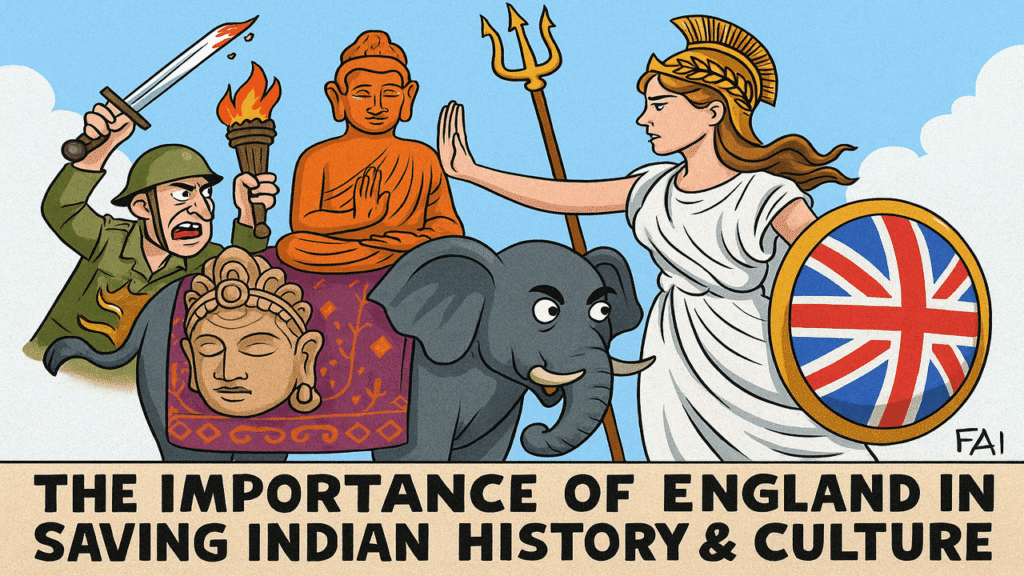
Changing A Common Misconception: The British Raj vs. Islamic Invasions in India
A common misconception in India is that British rulers were similarly cruel and Barbaric like Muslims and many Indians are taught to be hateful to England also but now a days new people from England keep on clearing the context that British Raj was different from Islamic Invasion of India.
Many English people who are literate would also like to give this good message to India that British were for shorter period of time in India and the British Raj was less cruel.
If you compare both Islamic Invasion in India & the British Raj then I would say British raj was some how better for Indian cultures survival in the overall History. You can say some how British & French rulers were some how indirect saviors of Hindu culture.
In the context of India’s history, many, including lawyers and UPSC teachers, argue that British rule was comparatively less brutal than the earlier Islamic invasions. They assert that the British brought stability, order, and progress to India, while the Islamic rulers were responsible for destruction, forced conversions, and brutality.
In this article, I’ll explore the belief that the British were better than the Islamic rulers, comparing the death tollsfrom both periods and offering a clearer perspective on the impact of both on Indian society.
Note : In this blog you are going to know about some Benefits that India got from British Rule & I & many others would believe that Jalainwala Baugh Massacre was the biggest negative of the British Rule that gets Indians away from Britishers.
The Brutality of Islamic Invasions
The Islamic invasions of India began in the 8th century with Muhammad bin Qasim, and continued through the Delhi Sultanate and Mughal Empire. These invasions were characterized by extreme violence, temple destruction, and forced conversions. The death toll from these invasions is estimated to be in the millions.
- Mahmud of Ghazni invaded India 17 times between 1001 and 1027. His raids were particularly destructive, and the Somnath Temple was famously destroyed.
- The Delhi Sultanate, particularly under rulers like Alauddin Khilji and Tamerlane (Timur), also caused widespread bloodshed, including the massacre of thousands and the destruction of entire cities.
Estimates suggest that millions of Hindus lost their lives in the violent campaigns of Islamic invaders, with some historians putting the death toll during these invasions at 20 million over several centuries. These figures are mentioned in works by K.K. Aziz and S.A.A. Rizvi.
Only a few Islamic Kings were known to be really great in Indian History and some literature say Akbar was the greatest King ever given by Islam to India because he was better than others and he reduced tax also on Non Muslim.
The British Raj: A Different Kind of Death Toll
When it comes to British rule (1858–1947), while it wasn’t marked by large-scale massacres or temple destructionlike the Islamic invasions, it still caused the death of millions of Indians—though largely through indirect means like economic exploitation, famines, and political repression. Here’s the breakdown:
Famine and Taxation-Related Deaths
The British government’s policies, such as taxation and the export of grain during famines, led to millions of deaths. However, these deaths were not caused by direct violence but by mismanagement and neglect, particularly during the famines of the 19th century and World War II.
- Bengal Famine of 1943: Approximately 3 million people died during this famine, which worsened due to British wartime policies. The famine’s death toll was exacerbated by World War II, as food supplies were redirected for the war effort.
- Great Famine of 1876-1878: This famine killed around 6-10 million people, mostly in southern India. British policies, such as monoculture agriculture and food grain exports, played a significant role in the death toll.
- Other Famines: Throughout British rule, many other famines, like the Orissa Famine (1866) and Madras Famine (1877), resulted in tens of thousands of deaths.
As Shashi Tharoor notes in his book, “An Era of Darkness”, the British economic policies, including the “drain of wealth”, contributed significantly to India’s suffering during the colonial period. These policies didn’t result in immediate deaths, but they indirectly led to widespread famine and poverty.
Military Repression and Revolts
During events like the Indian Revolt of 1857, thousands were killed in violent repression by the British. While estimates vary, it’s believed that 100,000 to 200,000 people died due to military action and executions.
Comparing the Death Tolls: Islamic Invasions vs. British Rule
When comparing the death tolls between the Islamic invasions and the British Raj, the Islamic invasions were marked by much more direct violence, while British rule caused a more indirect toll due to famines and economic exploitation.
Islamic Invasions:
- The death toll from Islamic invasions is often estimated to be in the millions due to the violent nature of the conquest, forced conversions, and massacres. Some estimates suggest 20 million Hindus were killed during these invasions.
British Raj:
- While the British Raj did not engage in large-scale violence or religious conversions, famines caused by British policies were devastating. The Bengal Famine of 1943 alone caused the deaths of 3 million people.
- Economic policies under British rule—such as deindustrialization and monoculture agriculture—exacerbated the situation, contributing to the deaths of millions due to poverty, malnutrition, and disease.
- The total number of deaths attributed to British policies (including famines, political repression, and economic exploitation) is estimated to be 20–30 million over the duration of British rule.
All in all : A Complex Legacy
In summary, the Islamic invasions were far more directly violent, with millions of Hindus killed in massacres, forced conversions, and military conquests. On the other hand, British rule led to the deaths of millions, but primarily due to economic exploitation, famines, and political repression. The Bengal Famine of 1943 and other famines under British rule caused massive loss of life, but these deaths were largely indirect and not the result of violent attacks.
While both periods had devastating impacts, the Islamic invasions were more marked by immediate violence, whereas the British Raj caused suffering over a longer period through economic policies that led to widespread famine and poverty.
References:
- K.K. Aziz, The Murder of History
- S.A.A. Rizvi, History of the Muslims of India
- Shashi Tharoor, An Era of Darkness: The British Empire in India
- Utsa Patnaik, The Agrarian Question and the Colonial State in India, The Agrarian Question and the Development of Capitalism in India
- Denying Death: The Bengal Famine of 1943, by Joya Chatterji
- Amartya Sen, Poverty and Famines: An Essay on Entitlement and Deprivation
Main Difference between Islamic Rulers & British Rule in India was Religious Conversions :
When we look at India’s history, it’s clear that both Muslim rulers and the British had significant impacts on the country’s religious landscape. While Muslims were more directly involved in converting people to Islam, the British influenced the spread of Christianity in a more indirect manner. Let’s dive into the details of how both these groups shaped India’s religious dynamics.
Muslim Influence and Conversion (12th – 16th Century)
During the medieval period, Muslim rulers and Sufi missionaries were instrumental in spreading Islam across India. The Delhi Sultanate and the Mughal Empire were key players in this process, especially in northern and central India.
- Sufi saints played a critical role by emphasizing spiritualism and connecting with marginalized and lower-caste communities. This approach made Islam appealing to many who were seeking social mobility and new opportunities. Their teachings led to a significant number of conversions.
- Mughal rulers, especially Akbar, practiced religious tolerance, but their rule still had a profound influence on Indian culture, administration, and daily life. The spread of Islam during this time was gradual, with many people converting due to political influence, economic opportunities, and the overall impact of Muslim culture.
While conversions were often peaceful, there were also instances of forced conversions, particularly in the earlier periods of Islamic rule.
British Influence and Christianity (17th – 19th Century)
While the British didn’t have as profound an effect on religious conversions as the Muslims, their influence in spreading Christianity is still noteworthy, especially during the 17th to 19th centuries.
- Christian missionaries from the Church of England focused on spreading Christianity through education and social reforms. They set up schools, colleges, and hospitals throughout India, particularly in the south and northeastern regions, and used these platforms to share Christian teachings.
- Goa, which was under Portuguese rule at the time, saw early Christian conversions. However, British efforts helped expand Christianity in areas like Kerala, parts of Tamil Nadu, and the Northeast, although the scale of conversions was much smaller compared to the Muslim period.
While Christianity did gain followers, particularly in regions where missionaries had set up schools and healthcare systems, the overall impact was limited. The majority of Indians continued to practice Hinduism, Sikhism, and Buddhism.
Key Differences in Impact
- Muslim Conversion: The spread of Islam was much more widespread across India, especially in the northern regions. It was deeply intertwined with political power, cultural influence, and the work of Sufi missionaries. Islam’s influence on social and cultural life was profound and lasting.
- British Influence on Christianity: The British impact on religious conversions was much smaller in scale and confined to specific regions. Although many Indians did convert to Christianity, especially in areas like Keralaand the Northeast, the majority of the population remained rooted in their indigenous religions. The British influence, while significant in educational and social terms, didn’t cause as widespread a religious shift.
All in all
In short, Muslims played a much larger role in converting Indians to Islam, with their influence being felt across much of the subcontinent, especially through political and cultural means. The British, on the other hand, contributed to the spread of Christianity through missionary work, but their impact was more localized and less forceful.
While both groups shaped India’s religious landscape, their methods, reach, and results were quite different, leaving lasting legacies in the country’s history.
The Islamic Invasions and the Struggle for Indian Territory: The Rise of British and French Power
When we look at the history of India, one thing becomes clear: for over 700 years, the subcontinent was heavily impacted by Islamic invasions, which led to widespread destruction, forced conversions, and territorial changes. Temples were destroyed, cities were renamed, and a significant portion of India’s cultural heritage was lost during this period. It is important to note that by the time the British and French arrived in India, many Hindu kingdoms had already been weakened, and much of India’s cultural fabric had been altered under Islamic rule.
The Destruction of Hindu Culture and Temples During Islamic Invasions
The Islamic invasions, beginning in the 8th century with Muhammad bin Qasim in Sindh, were not just military conquests but also cultural campaigns that had a lasting impact on India. Over the centuries, Muslim rulers—from the Delhi Sultanate to the Mughal Empire—sought to expand their territories by subduing Hindu kingdoms and destroying Hindu religious sites.
- Ayodhya, one of the holiest places in Hinduism, was attacked and destroyed during these invasions. Babur, the founder of the Mughal Empire, is believed to have ordered the destruction of the Ram Janmabhoomi Temple in 1528, replacing it with the Babri Masjid, a symbol of the religious transformation that took place during the period.
- The Somnath Temple, an ancient site of immense religious significance, was plundered and destroyed by Mahmud of Ghazni in 1025, marking one of the earliest and most significant attacks on Hindu temples during the Islamic period.
- Cities like Delhi, Mathura, and Varanasi also saw extensive damage during these invasions, with many templesand cultural institutions destroyed, and the cities themselves often renamed in accordance with Islamic traditions. Delhi was even renamed Shahjahanabad under the Mughal Empire.
As a result, by the time the British and French began to establish their presence in India in the 17th century, much of the subcontinent had already been shaped by centuries of Islamic rule, where Hinduism was marginalized in many regions.
The Emergence of British and French Power: The Real Struggle for Territory
With the weakening of many Hindu kingdoms and the rise of Mughal dominance, India saw the entry of European powers, first the Portuguese, and later the French and British, who were primarily motivated by trade. However, once these powers established themselves, they found themselves embroiled in a real struggle for control over India.
The battle for territory and control between the British, French, and the Islamic kingdoms (including the Mughal Empire and various regional Muslim sultanates) led to several key battles and wars:
Major Wars and Battles between the English, French, and Islamic Rulers:
- Battle of Plassey (1757):
- Fought between the British East India Company and the Nawabs of Bengal along with their French allies, the British victory at Plassey marked the beginning of British dominance in India, particularly in Bengal. The defeat of Siraj-ud-Daula (the Nawab of Bengal) and his French allies led to the establishment of British control in the Bengal region.
- Battle of Wandiwash (1760):
- This decisive battle between the French and the British in Southern India saw the British defeat the French and solidify their control over the region, especially in Tamil Nadu. It was a significant blow to French ambitions in India and marked a turning point in the European struggle for dominance.
- Anglo-Mysore Wars (1767–1799):
- These were a series of wars between the British East India Company and the Kingdom of Mysore, led by the formidable ruler Tipu Sultan. Despite initial successes by Tipu Sultan, the British ultimately emerged victorious, bringing the Deccan Plateau under British control and severely weakening Mysore’s power.
- Maratha Wars (1775–1818):
- The British fought several wars against the Maratha Empire, one of the most powerful Hindu kingdoms in India, which had managed to resist Islamic rule in the 16th and 17th centuries. The British victory in these wars ultimately led to the downfall of the Maratha Empire, with most of India falling under British control.
- Second Anglo-Sikh War (1848-1849):
- The British fought against the Sikh Empire, which was one of the last significant indigenous powers in the northwestern region of India. After the defeat of Sikh forces, the Punjab region was annexed into British India, cementing British dominance over the northern frontier.
- The Battle of Buxar (1764):
- This battle was fought between the British East India Company and a coalition of Indian rulers, including the Mughal Emperor and the Nawab of Oudh. The British victory helped solidify their power in Bengal and laid the foundation for British rule in India.
Key Insights:
- By the time the British and French powers engaged in these wars, many Hindu kingdoms had already been weakened or defeated by centuries of Islamic invasions.
- Ayodhya and other sacred sites had already suffered significant destruction, and many Hindu cities had either been renamed or repurposed under Islamic rule.
- The arrival of the British and French didn’t mark the beginning of the fight for Indian control—it was rather the continuation of a much longer process that saw the decline of Hindu power, first under Islamic rulers and later under European colonial forces.
Final Words : The Changing Face of India’s History
By the time the British and French arrived, much of India’s religious and cultural landscape had already been transformed by centuries of Islamic rule. While Hindu kingdoms had endured invasions and destruction, the European powers entered India not just as traders, but as conquerors, ready to fight each other and the Islamic rulersto control vast territories. The wars between the British and French during the 18th century, and the subsequent conquest of Punjab and Southern India, were the final chapters in the battle for control over a land that had seen centuries of religious and political transformation.
The Role of the British and French in Preserving Indian Culture
- Technological Advancements:
- The British introduced railways, telecommunication systems, and modern education in India. While these advancements were largely for colonial control, they inadvertently helped unify India and laid the foundation for India’s post-independence development.
- The French influence in Pondicherry is a prime example, where French architecture, culture, and linguistic ties have persisted, helping preserve some unique cultural aspects in India, particularly in the south.
- Religious Tolerance:
- Unlike the Islamic invasions, which often involved forceful conversions and the destruction of Hindu temples, the British and French didn’t engage in such practices on a large scale. While they did have Christian missionary activity, it was relatively confined and didn’t cause the same level of cultural damage as the Islamic rule did.
- Leaving Early:
- Both the British and French left India after relatively short periods in terms of ruling duration, especially when compared to the Islamic rulers, who controlled much of India for centuries. Their departure in the mid-20th century allowed India to reclaim its sovereignty and begin shaping its own identity post-colonialism.
- Impact of World War II:
- The World War II era played a key role in accelerating the decolonization process. British and French colonial powers were weakened by the war, which gave rise to nationalist movements and the eventual independence of many colonies, including India.
- Cultural Preservation:
- Despite their flaws, the British did not completely destroy India’s cultural heritage like the Islamic invasions. Hinduism continued to thrive under British rule, with cultural movements and reforms happening during this period, such as the Bengal Renaissance. French territories like Pondicherry still reflect a blend of Indian and French cultures, a reminder of their relatively less disruptive colonial rule.
- Military Power and Defenses:
- During the period of Islamic invasions, while figures like Shivaji Maharaj and Maharana Pratapprovided significant resistance, they did so with limited resources and military power. The arrival of the British and French also helped lay the foundation for modern Indian military strategy and defense mechanisms.
- Islamic Terrorism and Partition:
- The Islamic invasions played a major role in the partition of India into Pakistan and Bangladesh, and this division has had enduring impacts on Hindu-Muslim relations in the region. The rise of Islamic terrorism today is deeply rooted in political and religious divisions that originated during the period of Islamic rule and was exacerbated during the Partition of 1947.
Brutal Acts by the British and French:
- Jallianwala Bagh (1919):
- The Jallianwala Bagh massacre is one of the most infamous examples of British brutality. General Dyerordered the massacre of hundreds of unarmed Indian civilians, which remains a symbol of British oppression in India.
- French Attacks:
- While the French didn’t engage in massacres on the scale of the British, their colonial rule was marked by some harsh suppression. One example is the French repression of Indian revolts in their territories. The Battle of Pondicherry (1761) during the Seven Years’ War was one instance where French forces clashed with the British, affecting local populations.
- Suppression of Rebellions:
- Both the British and French engaged in violent suppression of revolts. The Indian Rebellion of 1857, known as the First War of Indian Independence, saw numerous brutal actions by the British in quelling the uprising. Similarly, the French had to face significant resistance from Indian rulers during the French and Indian Wars and other local revolts.
The Relative Benefits of British and French Presence in India
When comparing British and French rule to the earlier Islamic invasions, there’s a clear distinction. While the British and French were certainly exploitative, they preserved India’s cultural and religious diversity far more than the Islamic rulers, who had a more direct role in cultural destruction and the spread of Islam.
The Islamic invasions were much more brutal in their immediate impact, leading to large-scale destruction, the creation of Pakistan and Bangladesh, and religious tensions that still resonate today. Meanwhile, the British and French brought technological advancements, left relatively sooner, and were less focused on forced religious conversion.
In the end, while the British Raj and French colonialism were far from ideal, they allowed India to retain much of its cultural heritage, and their departure in the mid-20th century opened the door for India’s eventual independence. While Shivaji Maharaj and other Hindu leaders fought valiantly during the Islamic period, the British and French ultimately played a more positive role in preserving India’s culture and allowing for a gradual transition to independence.
Examples of How the British and French Helped Preserve Indian Culture:
1. Preservation of Architecture and Monuments:
- British Colonial Architecture:
The British built many iconic buildings and structures that reflect a blend of European and Indian architectural styles. These buildings often used local craftsmanship but followed Western architectural designs, thus preserving local artistry while creating new traditions in urban planning. Victoria Memorial in Kolkata, India Gate in Delhi, and The Gateway of India in Mumbai are examples of this fusion.- Conservation Efforts: British administrators like Lord Curzon were deeply invested in preserving Indian monuments, especially after the devastating Islamic invasions had left many sites damaged. Lord Curzon established the Archaeological Survey of India (ASI) in 1861, which led to the restoration of major Hindu temples and ancient monuments across the country, including the Khajuraho temples and Ajanta and Ellora caves. This marked the first significant effort at protecting India’s cultural heritage after centuries of neglect and destruction.
2. Preservation of Art, Literature, and Texts:
- British Scholarship on Indian Culture:
The British colonial era saw the emergence of a significant amount of scholarship on Indian culture. Scholars like Sir William Jones, who founded the Asiatic Society of Bengal in 1784, studied and documented ancient Indian texts, such as the Vedas, Mahabharata, and Ramayana. Jones and his contemporaries played a significant role in the preservation of Sanskrit and ancient Indian knowledge, which may otherwise have been lost.- Translation of Texts: The British made translations of many Indian epics and philosophical texts, making them accessible to a wider audience. The British East India Company took a keen interest in Indian literature, and many classical works were translated into English, such as the Bhagavad Gita, Upanishads, and Manusmriti. These translations helped preserve key elements of Hindu philosophy and Indian culture for posterity.
3. Revival of Hindu Religious Practices and Traditions:
- Reform Movements: The British rule indirectly influenced the Hindu reform movements of the 19th century, such as the Brahmo Samaj (founded by Raja Ram Mohan Roy) and the Arya Samaj (founded by Swami Dayananda Saraswati). These movements were partly a reaction to British social and religious reforms, but they also revived and preserved core aspects of Hinduism, which were threatened by the Islamic invasions.
- Raja Ram Mohan Roy played an important role in the abolition of Sati (the practice of widow burning) and promoted the study of Sanskrit, Vedic texts, and Hindu philosophy. This focus on Hindu scripture and traditions was a form of cultural preservation in the face of both Islamic domination and British colonialism.
4. Preservation of Language and Literature:
- English as a Lingua Franca: While English was imposed by the British for administrative purposes, it also acted as a unifying language across India, which helped preserve regional languages and literature. The British education system, though elitist and exclusionary, created an educated class of Indian intellectuals who began to engage in literary and cultural pursuits. This included the writing of novels, poetry, and plays that explored Indian culture and history.
- Writers like Rabindranath Tagore (who later became the first non-European to win the Nobel Prize in Literature) were influenced by the British education system. Tagore’s works, including Gitanjali (Song Offerings), helped preserve Indian identity in the face of colonial challenges and became internationally recognized.
5. French Influence in Pondicherry:
- French Architecture and Culture: In the French territories, particularly Pondicherry, French architecture and urban planning were preserved. The French influence in Pondicherry created a unique blend of French and Indian cultures, visible in the city’s architecture, language, and lifestyle. Even today, the French influence is evident in Pondicherry’s colonial-era buildings, churches, and streets, which continue to be preserved as part of India’s cultural heritage.
- French colonial rule in India, particularly in the south, is also remembered in Auroville (a community founded by Mirra Alfassa, known as The Mother, who was a close disciple of Sri Aurobindo). Sri Aurobindo himself took refuge in French-controlled territories to avoid British repression, which allowed his ideas to flourish.
6. Preserving Hinduism Through Education:
- Christian Missionaries and Education: Though Christian missionaries were active in spreading Christianity, their contributions to education and healthcare were significant. The schools and hospitals established by missionaries became important centers for education and social reforms. Missionary schools often taught Sanskrit, Hindu philosophy, and Indian literature, indirectly contributing to the preservation of Hindu culture.
- In some regions, missionaries worked closely with local Hindu scholars and preserved ancient knowledge, although their religious agenda sometimes conflicted with this. Nevertheless, the educational framework set up by missionaries helped preserve some aspects of Indian culture, particularly in rural areas.
7. Preservation of Cultural Practices Through Social Reforms:
- The British also influenced the social landscape of India by enforcing laws against practices such as Sati (the burning of widows), child marriage, and the untouchability system. While these laws were often introduced for humanitarian reasons, they also preserved Hindu society from practices that might have otherwise continued under the guise of tradition. Although these reforms were often driven by the British need to “civilize” India, they helped preserve the dignity of Hindu social structures and brought some level of equality for the marginalized.
8. APMC & Mandi :
The Mandi System (regulated agricultural markets) was formally introduced by the British through the Punjab Agricultural Produce Markets Act, 1928, with the first regulated mandi set up at Karanjia, Punjab. Its key benefits included reduction of middlemen exploitation, transparent price discovery through auctions, standardization of weighing and grading, creation of rural infrastructure such as roads, warehouses, and cold storage, and later, after independence, its integration into the Agricultural Produce Market Committees (APMCs) system, which became the backbone of the Minimum Support Price (MSP) mechanism and supported the Green Revolution and national food security.
All in all :
While British and French colonialism had its share of exploitation and oppression, it also left behind a legacy of preserving, documenting, and protecting aspects of Indian culture. The British initiated many preservation efforts, especially concerning India’s ancient monuments, literature, and religious traditions, and the French in their territories left a lasting mark on architecture and social life.
India’s cultural preservation during the colonial period, while not always intentional on the part of the colonizers, played a critical role in ensuring that Hindu traditions and heritage survived for future generations, especially when compared to the Islamic invasions that resulted in more direct and systemic destruction.
So this was it regarding significance of England & French and other European presence in India while Islamic Invasion and how indirectly Hinduism & India can get freedom from more brutal Islamic invasions.
I hope you got more clear point of view about Indian Politics and History which most of people would not find in Government books.
Good Luck