
Disclaimer : We don’t directly give advice to buy or sell shares or anything. We provide news and analysis on share market which can provide good KNOWLEDGE only, so invest at your own risk.
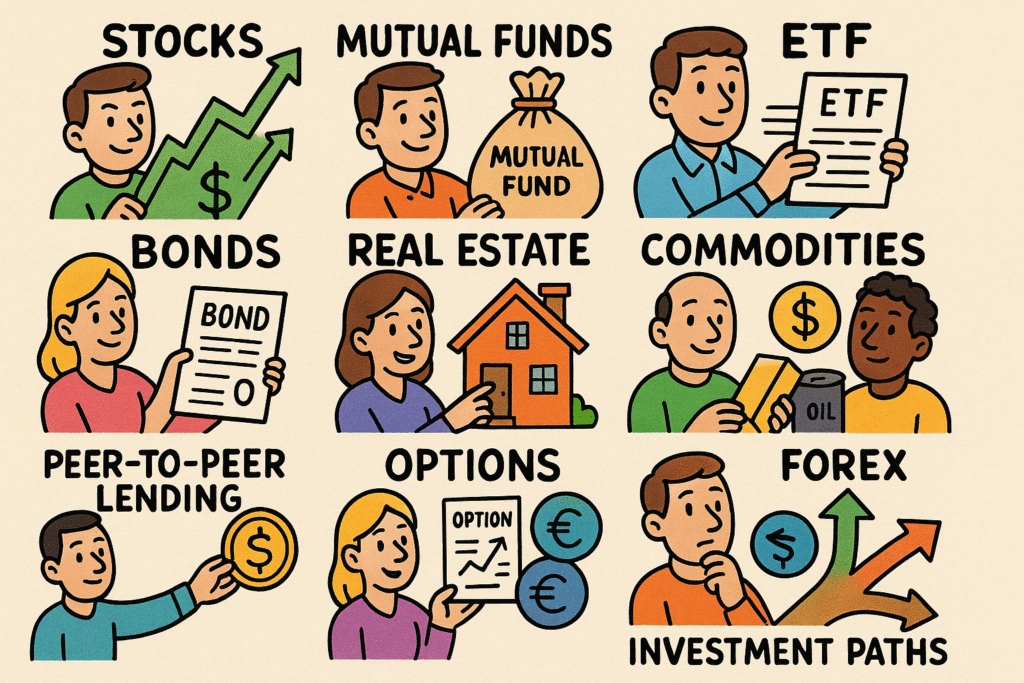
In this stock market article we are going to see Investment Options just like stocks but different than stocks. These are important Investment options or paths everyone should know about because it shows that stocks are not the only things where you can invest.
So, let’s begin :
1. What Are Stocks? (Definition)
A stock represents a unit of ownership in a company. When you buy a stock (also called a share or equity), you become a partial owner of that company.
Your returns come from:
- Capital appreciation (price increase)
- Dividends (profit share distributed by the company)
In simple terms:
You are investing in one company and your profits depend on how well that specific company performs.
2. What Is a Mutual Fund? (Definition)
A mutual fund is an investment product that pools money from many investors and invests it in a diversified portfolio of assets such as stocks, bonds, gold, or a mix of them.
It is managed by a professional fund manager, and its value is measured by NAV (Net Asset Value), calculated once per day.
In simple terms:
Your money is combined with others and professionally managed in a diversified basket of investments.
3. What Is an ETF (Exchange-Traded Fund)? (Definition)
An ETF is a type of pooled investment vehicle (like a mutual fund) that holds a basket of securities, but it is listed and traded on a stock exchange, just like a stock.
Most ETFs passively track an index such as Nifty 50, Sensex, Nasdaq 100, etc.
In simple terms:
An ETF is a mutual fund that you can buy and sell on the stock exchange throughout the day at market prices.
Difference between Stocks, Mutual Funds & ETFs :
1. Where You Can Invest
Stocks
- You invest in a single company (TCS, Reliance, HDFC Bank, etc.)
- No diversification unless you buy multiple stocks yourself.
Mutual Funds
- You invest in a basket of many companies, bonds, or assets.
- Diversification happens automatically.
ETFs
- You invest in a basket of securities, usually tracking an index like Nifty 50, Sensex, Bank Nifty, Gold, etc.
- Portfolio is similar to mutual funds but traded like stocks.
2. Who Manages Them
Stocks
- Self-managed
- Investor decides what to buy, sell, or hold.
Mutual Funds
- Managed by a professional fund manager under an AMC (Asset Management Company).
- Regulated by SEBI.
- Asset Management Companies like SBI, HDFC Mutual Funds, JP Morgan Asset Management, Fidelity Investment.
ETFs
- Managed by a fund house but usually passively (following an index).
- Also regulated by SEBI.
3. Traded On? (Buying & Selling Method)
Stocks
- Traded directly on the stock exchanges: NSE & BSE
- Buy/sell anytime during market hours at market price.
Mutual Funds
- Not traded on exchanges
- Bought through AMC, distributors, or apps.
- Price calculated once daily as NAV.
ETFs
- Listed on NSE & BSE
- Traded intraday like stocks at live market prices.
- You need a Demat account (unlike mutual funds).
4. Cost Structure (Expenses)
Stocks
- No fund management charges
- Only brokerage + small exchange charges
- Lowest cost structure
Mutual Funds
- Have expense ratios (fund management fees)
- Actively managed funds charge higher fees
- Can be significant over long term
ETFs
- Extremely low expense ratios (mostly passive)
- Lower than mutual funds
- Brokerage applies when buying/selling
5. Liquidity
Stocks
- Highly liquid
- Buy or sell instantly during market hours
Mutual Funds
- Less liquid
- Redemption takes 1–3 days to reflect in bank
- No intraday liquidity
ETFs
- Liquid only if trading volume is good
- Can buy/sell instantly on exchange
- Liquidity depends on market demand
6. Investment Style (Trading vs Long Term)
Stocks
- Suitable for:
- Short-term trading
- Long-term investing
- Fully flexible
Mutual Funds
- Best for long-term investing (SIP/ lumpsum)
- Not ideal for trading because no intraday buying/selling
ETFs
- Suitable for:
- Long-term diversification
- Short-term trading (because they move intraday)
- Hybrid between stocks & mutual funds
7. Risk Level
Stocks
- Highest risk (depends on a single company)
- High return potential
Mutual Funds
- Moderate risk
- Risk reduced through diversification
ETFs
- Moderate risk
- Usually track large market indices
- Less risky than stocks, often cheaper than MFs
8. Ideal For (Who Should Invest?)
Stocks
- Experienced investors
- Those who like research & active management
Mutual Funds
- Beginners
- Long-term wealth creation
- People who prefer professional management
ETFs
- Investors looking for:
- Low fees
- Diversification
- Ability to trade like stocks
8 Best Investments other than Stock Market :
1. Index Funds
Index funds are passive mutual funds that track a stock market index such as Nifty 50, Sensex, Nifty Next 50, Nifty Bank, etc.
Why Consider Index Funds?
- Low cost (lower expense ratio than active funds)
- Historically strong long-term performance
- No Demat account required
- Ideal for beginners and passive investors
Index funds are the mutual-fund version of ETFs.
2. REITs (Real Estate Investment Trusts)
REITs invest in income-producing commercial properties such as offices, malls, hotels, and warehouses.
Benefits
- Earn rental income + capital appreciation
- Lower entry cost compared to buying property
- Trade on stock exchanges like shares
- Good diversification for investors wanting real estate exposure
Examples: Embassy REIT, Mindspace REIT, Brookfield REIT
3. InvITs (Infrastructure Investment Trusts)
InvITs invest in infrastructure assets such as highways, toll roads, power transmission lines, renewable energy projects, etc.
Benefits
- Regular cash flow
- Lower volatility than equities
- Backed by stable infrastructure revenues
Good for income-focused investors.
4. Bonds (Government + Corporate)
Bonds are fixed-income instruments that pay interest regularly.
Types You Can Invest In
- Government Securities (G-Secs)
- State Development Loans (SDLs)
- Corporate Bonds
- PSU Bonds
- Bond ETFs / Debt Mutual Funds
Why Bonds?
- Much safer than equities
- Provide steady interest
- Useful for stability in your portfolio
5. Sovereign Gold Bonds (SGBs)
SGBs are government-backed digital gold investments.
Benefits
- 2.5% annual interest on your gold value
- No capital-gains tax if held till maturity (8 years)
- No storage or making charges
- Very safe (issued by RBI on behalf of the Government of India)
Better than physical gold for long-term wealth creation.
6. Target Maturity Funds (TMFs)
TMFs are debt mutual funds with a fixed maturity year like 2027, 2030, 2035, etc.
Why Investors Like TMFs
- Predictability: returns converge close to yield at the time of investing
- Mostly invest in G-Secs, PSU bonds
- More tax-efficient than FDs if held over 3 years
- Lower risk than active debt funds
Great for medium to long-term goals.
7. International ETFs & Mutual Funds
These allow you to invest in global markets.
Popular Themes
- Nasdaq 100
- S&P 500
- Global Technology
- US Treasury Bonds
- Emerging Markets
Why Invest Globally?
- Reduces risk of being dependent only on the Indian market
- Gives exposure to world-leading companies like Apple, Google, Tesla, Microsoft
8. Thematic & Sector Funds
These invest in a theme or sector rather than the entire market.
Popular Sectors
- EV & Battery technology
- Pharma
- PSU
- Banking & Financials
- Defence
- IT
- Energy
- Consumption
Why Consider Them?
- High-growth potential
- Good for tactical bets
But riskier than diversified funds.
Summary :
| Category | What It Invests In | Risk Level |
|---|---|---|
| Index Funds | Market indices | Low–Moderate |
| REITs | Commercial real estate | Moderate |
| InvITs | Infrastructure assets | Low–Moderate |
| Bonds | Govt & corporate debt | Low |
| SGBs | Digital gold | Low |
| TMFs | Fixed-maturity debt | Low–Moderate |
| International ETFs | Global markets | Moderate |
| Thematic Funds | Specific sectors/themes | High |
Final Words : Where to Trade, Invest & Access in these 10 different Investment Assets
1. Stocks
Where to Buy/Sell
- Stock Exchanges: NSE & BSE
- Through:
- Zerodha
- Groww
- Upstox
- Angel One
- ICICI Direct
- HDFC Securities
- Kotak Securities
Requirement: Demat + Trading account
2. Mutual Funds
Where to Buy/Sell
- Directly from AMC websites (SBI MF, HDFC MF, ICICI Prudential, UTI, etc.)
- Aggregator apps:
- Groww
- Zerodha Coin
- Paytm Money
- ET Money
- Kuvera
- Banks also offer MF investment services.
No Demat account required.
Price basis: NAV (calculated once daily)
3. ETFs (Exchange Traded Funds)
Where to Buy/Sell
- NSE & BSE (like stocks)
- Through any stockbroker: Zerodha, Groww, Upstox etc.
Requirement: Demat + Trading account
Price basis: Live market price (intraday)
4. Index Funds
Where to Buy/Sell
- AMC websites (HDFC, ICICI, UTI, Kotak, Mirae Asset, Motilal Oswal, etc.)
- Apps: Groww, Zerodha Coin, ET Money, Paytm Money
No Demat needed.
5. REITs (Real Estate Investment Trusts)
Where to Buy/Sell
- NSE & BSE (just like stocks)
- Via stockbrokers: Zerodha, Groww, Upstox
Demat account required.
6. InvITs (Infrastructure Investment Trusts)
Where to Buy/Sell
- NSE & BSE
- Using your regular stockbroker
Demat account required.
7. Bonds (Government + Corporate)
Where to Buy/Sell Government Bonds (G-Secs, SDLs)
- RBI Retail Direct Portal (direct from RBI)
- Stock exchanges through brokers (NSE/BSE)
- BSE Direct (ASBA-enabled)
- Banks (for some bond issues)
Where to Buy Corporate Bonds / PSU Bonds
- NSE/BSE via stockbrokers
- Bond investment platforms:
- GoldenPi
- IndiaBonds
- Wint Wealth
- Zerodha (via “Bonds” section)
Settlement usually in Demat form.
8. Sovereign Gold Bonds (SGBs)
Where to Buy
- RBI subscription windows (announced throughout the year)
- Banks (online + offline)
- Post Offices
- Stockbrokers (Zerodha, Groww, Upstox)
Where to Buy/Sell in Secondary Market
- On NSE/BSE (traded like shares)
Demat optional (can buy in certificate form).
9. Target Maturity Funds (TMFs)
Where to Buy/Sell
- AMC websites (Edelweiss, Nippon, ICICI, etc.)
- Apps: Zerodha Coin, Groww, Paytm Money, ET Money
No Demat account needed (unless buying ETF version).
10. International ETFs / Funds
Where to Buy/Sell
- International ETFs (India-listed funds tracking foreign indices):
- Traded on NSE/BSE via stockbrokers
- Example: Motilal Oswal Nasdaq 100 ETF, Nippon India Hang Seng ETF
- International Mutual Funds:
- Available via AMC websites and MF apps (Groww, Coin, etc.)
Note: Direct foreign stock investing requires LRS + broker like Vested, INDmoney, or Interactive Brokers.
11. Thematic & Sector Funds
Where to Buy
- AMC websites
- Apps like Groww, Coin, Kuvera, ET Money
- Banks (for some fund houses)
No Demat required.
Summary of Where to Access Investment Assets :
| Investment Type | Where to Buy/Sell |
|---|---|
| Stocks | NSE/BSE via stockbrokers |
| Mutual Funds | AMC sites, MF apps (Groww, Coin) |
| ETFs | NSE/BSE via stockbrokers |
| Index Funds | AMC websites, MF apps |
| REITs | NSE/BSE via stockbrokers |
| InvITs | NSE/BSE via stockbrokers |
| Bonds | RBI Retail Direct, NSE/BSE, bond platforms |
| SGBs | Banks, Post Office, Brokers, NSE/BSE |
| TMFs | AMC websites, MF apps |
| International ETFs | NSE/BSE via brokers |
| International MF | AMC websites, MF apps |
So, this was it regarding 11 Best Investment options plus difference between ETFs, Mutual Funds & Shares or Stocks. I hope this article will be helpful to you and you will get better knowledge out of it.
Happy Investing