
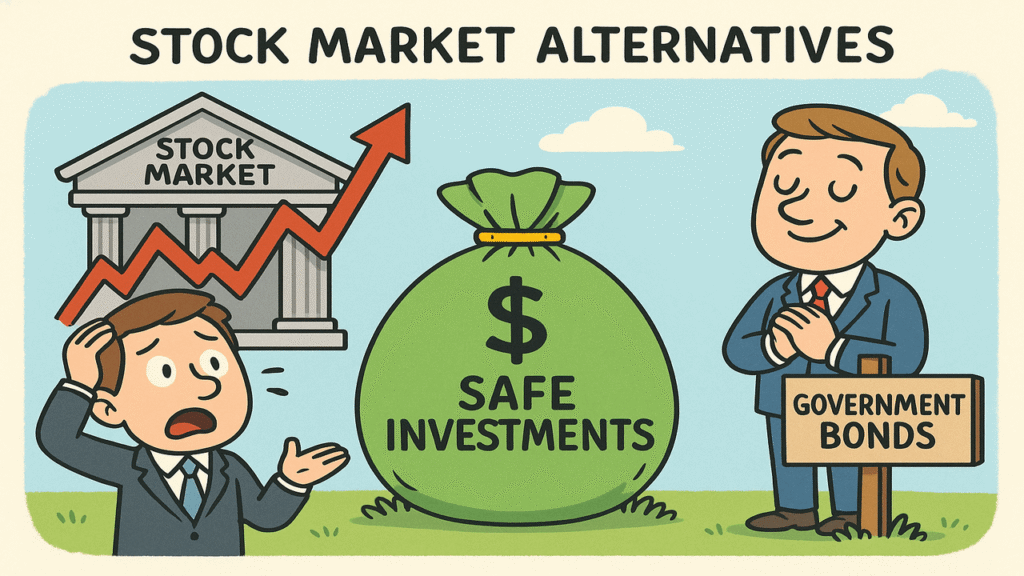
In this share market & Investment related article we are going to see some of the best alternatives to Stock Market which are safer than Stock Market.
Many People invest in Stock Market to make profit and many times we do not get the results that we really expected. Many times Stock Market give you negative results as well. So in these kinds of situation we would ask for safer options & yes, there are safer options to stock market.
Read this article full, for full information.
Safe Alternatives to Stock Market: Understanding Bonds Around the World
What Are Bonds?
A bond is a financial instrument where you lend money to a government or company for a fixed period in exchange for regular interest payments and the return of your original amount (principal) at maturity.
In simple terms:
You act as the lender, and the government (or company) acts as the borrower.
Bonds are considered safer than stocks because:
- You get a fixed income (interest or “coupon”).
- Your principal is usually guaranteed (especially in government bonds).
- They are less volatile compared to the ups and downs of stock markets.
How Are Bonds Different from Stocks?
| Feature | Bonds | Stocks |
|---|---|---|
| Ownership | You are a lender to the government or company | You are a part-owner (shareholder) |
| Returns | Fixed interest (predictable) | Dividends + price appreciation (unpredictable) |
| Risk Level | Low to moderate | Moderate to high |
| Market Volatility | Low | High |
| Maturity | Fixed (e.g., 5, 10, or 20 years) | No fixed maturity |
| Government Guarantee | Yes (in sovereign bonds) | No |
Countries Offering Safer Alternatives to Stock Markets
Across the world, several countries issue government-backed investment options designed for safety.
Here’s a summary of some of the most reliable and low-risk choices:
| Region | Country | Safe Investment Type |
|---|---|---|
| Asia | India | Sovereign Gold Bonds, RBI Bonds |
| North America | USA | Treasury Bonds, I Bonds |
| Europe | United Kingdom | Gilts, Premium Bonds |
| Oceania | Australia | Government Bonds, Indexed Bonds |
| North America | Canada | Government Bonds, Real Return Bonds |
| Africa | South Africa, Nigeria, Kenya | Treasury or Savings Bonds |
| Latin America | Brazil, Mexico, Chile | Inflation-linked Government Bonds |
Details of Safe Government Bonds by Country
India
- Main Bonds:
- Sovereign Gold Bonds (SGBs) – value linked to gold price + 2.5% annual interest.
- RBI Floating Rate Savings Bonds – interest changes with market rate (~8% currently).
- Tenure: 8 years for SGBs (can exit after 5 years).
- Safety: 100% backed by the Government of India.
- Return Example: ₹1 lakh may grow ~2.5% yearly + gold price appreciation.
United States
- Main Bonds:
- Treasury Bills (T-Bills) – short-term (3–12 months).
- Treasury Notes (T-Notes) – 2–10 years.
- Treasury Bonds (T-Bonds) – 20–30 years.
- Series I Savings Bonds – inflation-protected; interest ~5–6% recently.
- Safety: U.S. government guaranteed.
- Maturity: 1 to 30 years depending on type.
- Return: Around 4–5% yearly, depending on inflation and interest rate trends.
United Kingdom
- Main Bonds:
- Gilts – Fixed or inflation-linked government bonds.
- Premium Bonds – No fixed interest; you enter monthly prize draws (tax-free).
- Maturity: 5–50 years for Gilts.
- Safety: Very high (UK Government).
- Return: Gilts currently yield ~4% annually; Premium Bonds depend on luck but ~3–4% average.
Australia
- Main Bonds:
- Treasury Bonds – Fixed-rate.
- Treasury Indexed Bonds – Inflation-linked.
- Maturity: 2 to 30 years.
- Safety: Australian Government guaranteed.
- Return: 3–4% for standard bonds, higher if inflation rises.
- Bonus Option: Superannuation funds also invest partly in bonds for stable returns.
Canada
- Main Bonds:
- Government of Canada Bonds – 2 to 30 years.
- Real Return Bonds – Inflation-linked.
- Return: 3–4% annual yield.
- Maturity: 3 to 30 years.
- Safety: Federal government guarantee.
- Extra Option: TFSA (Tax-Free Savings Account) — lets you invest in bonds or ETFs and earn tax-free income.
Africa (Examples)
- South Africa:
- Government Bonds and CPI-linked Bonds.
- Return: ~9–10% (due to higher inflation).
- Maturity: 5–20 years.
- Nigeria:
- FGN Savings Bonds (for retail investors).
- Interest: 10–13% annually (paid twice a year).
- Maturity: 2–10 years.
- Kenya:
- Treasury Bonds & Infrastructure Bonds.
- Interest: 12–14% (higher but riskier than developed nations).
Latin America
- Brazil:
- Tesouro IPCA+ (inflation-linked) – 5–6% + inflation.
- Maturity: 5–30 years.
- Access: Tesouro Direto platform (for citizens).
- Mexico:
- Udibonos – inflation-protected.
- Return: ~4–6% annually.
- Maturity: 3–30 years.
- Chile:
- BTU (UF-indexed bonds) – inflation-adjusted, extremely stable.
- Return: 3–5% real yield.
- Maturity: 5–20 years.
Do You Really Get Your Money Back?
Yes — in almost all government-backed bonds, your principal is returned in full when the bond matures.
Interest can be:
- Paid annually or semi-annually (most bonds), or
- Accumulated and paid at maturity (like savings bonds).
For example:
- India SGB: Get back equivalent gold value + 2.5% annual interest after 8 years.
- U.S. Treasury Bond: Full principal + interest over 10–30 years.
- Brazil IPCA+: Return adjusted for inflation + fixed interest.
Conclusion: Safe Doesn’t Mean Small – Alternatives to Stock Market
While government bonds may not give massive short-term profits like stocks, they offer:
- Capital safety
- Steady income
- Inflation protection (in some types)
- Guaranteed repayment
They’re ideal for:
- Long-term stability
- Diversifying risk
- Retirement-focused investing
If you want peace of mind instead of daily stock market stress, these global government bond options are the most reliable paths to financial safety.
Why the Stock Market Is Not Always Safe
While the stock market gives high returns over time, the reality is that a large majority of investors lose money, especially those who trade frequently or chase short-term profits.
🔹 How Many People Actually Lose Money
- Studies from different countries show that 70% to 90% of retail traders end up losing money.
- In India, SEBI’s 2024 report showed that 7 out of 10 intraday traders lost money.
- In the U.S., long-term data shows that average investors underperform the S&P 500 by over 6% per year, mostly because they buy and sell at the wrong times.
- Similar trends appear in Europe, Latin America, and Asia — most retail investors lose money due to emotional trading or lack of patience.
Why the Stock Market Feels Unsafe for Many
- High Volatility:
Stock prices can move sharply because of economic news, global events, or even rumors. This unpredictability makes it stressful and risky, especially for beginners. - Emotional Decisions:
Many investors sell when prices fall and buy when they rise — doing the exact opposite of what successful investing requires. Fear and greed often lead to losses. - Stock Picking Risk:
Only a small number of stocks generate most of the long-term profits. If you pick the wrong ones, your returns will lag behind the overall market. - Short-Term Trading:
People trying to make quick profits often lose due to brokerage fees, taxes, and bad timing. Over 90% of day traders globally end up with net losses. - Lack of Knowledge or Patience:
The market rewards discipline and time. Most retail investors don’t hold investments long enough to benefit from compounding.
What This Means for Investing
The stock market is naturally unsafe — it is built on volatility, speculation, and changing market sentiment. Prices rise and fall not only due to company performance, but also because of global events, interest rates, and investor psychology.
While long-term, disciplined investors may benefit, the truth is that for most people, especially small investors and traders, the stock market carries a real risk of losing capital.
That’s why for those who value stability, guaranteed returns, and peace of mind, government-backed options like Sovereign Bonds, Treasury Bonds, and Inflation-Linked Bonds are far safer choices.
They may not make you rich overnight, but they protect your money, give steady income, and ensure you actually get your investment back in full — something the stock market can never promise.
I think I have given you enough idea that there are alternatives to Stock Market for sure. So, search the web properly before investing into lesser safe things. Best of luck
Happy Investing.
Extra Reference :
Treasury Direct – For US Government Bonds related
Department of Finance – Canada
Africa – Ministry of Finance of Each Country or African Development Bank (For Whole Africa Info)
Ministry of Finance Mexico