
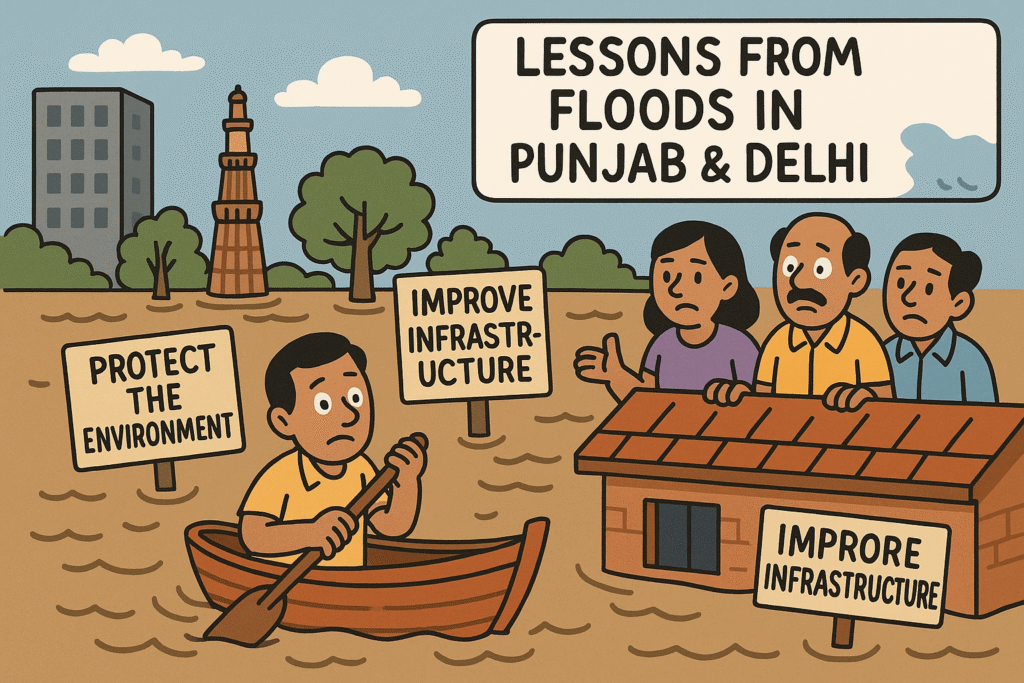
The Punjab floods have caused widespread devastation across the state, with over 51 reported deaths and extensive damage to crops and infrastructure. The floods have affected more than 3.87 lakh people across 15 districts, with approximately 1.84 lakh hectares of agricultural land submerged. The Punjab government estimates total losses to be around ₹14,000 crore, with severe impacts on agriculture, health services, and infrastructure. The central government has announced a relief package of ₹1,600 crore, in addition to the ₹12,000 crore already allocated. This aid will cover the restoration of national highways, schools, agricultural systems, and housing under schemes like PMAY. Farmers have been promised ₹20,000 per acre for crop loss, and families of the deceased will receive ₹4 lakh each. Compensation measures also include moratoriums on loans and assistance for livestock losses.
In terms of livestock, over 2.5 lakh animals, including cattle, sheep, goats, and poultry, have been impacted by the floods. The loss of animals and the destruction of fodder have added to the crisis, although veterinary teams have been deployed to treat the affected animals. The state has also suffered significant damage to its health sector, with losses amounting to ₹780 crore, including damage to medical supplies and hospitals. The state government has sought additional central aid, estimating that the recovery and reconstruction effort will require significant financial support. The floods have left a long-lasting impact on the local population and economy, requiring coordinated efforts for recovery and rehabilitation.
Extra Reference :
Comparison of Rainfall in the Last 50 Years
When comparing rainfall in 2025 to the past 50 years, it is evident that this year has witnessed some of the heaviest monsoons in recent history, with rainfall levels surpassing those of previous years. The India Meteorological Department (IMD) and state agencies have reported that the rainfall in Punjab and Delhi in 2025 has been significantly higher than average, breaking historical records.
In Punjab, the 2025 monsoon season saw rainfall that was approximately 30-40% higher than the average rainfallrecorded in the past decades. In particular, the months of August and September saw an exceptional surge in rainfall, triggering the overflow of rivers like the Sutlej, Beas, and Ravi, which led to devastating flooding. These rivers had already been at high levels due to increased snowmelt from the Himalayas caused by unseasonal weather patterns.
In Delhi, the rainfall in 2025 was also much higher compared to the historical averages. The city experienced intense and sustained rainfall, resulting in flash floods and severe waterlogging across multiple urban areas. The Delhi IMDreported that this year’s rainfall was about 50% more than the average rainfall recorded in previous years during the monsoon season. This increase in rainfall is part of the ongoing trend of unpredictable weather patterns linked to climate change, with Delhi’s flooding events reaching unprecedented levels since records began.
Rainfall in 2025: A Record-Breaking Year?
In both Punjab and Delhi, 2025 is on track to become one of the wettest years in the last half-century, setting new records in terms of rainfall.
For Punjab, the 2025 monsoon season has shattered rainfall records. According to the Punjab State Disaster Management Authority (PSDMA), rainfall during this period has been the highest since 1975, exceeding previous records by a considerable margin. This surge has overwhelmed the state’s flood management infrastructure, as rivers reached historic levels, submerging large tracts of farmland and displacing thousands of families.
Similarly, in Delhi, 2025 is being cited as a year with the one of the highest rainfall recorded with 2021, 2024, 1964. The city’s drainage systems have been tested beyond their capacity, with some areas experiencing rainfall that exceeded 100 mm in just a few hours, a rate not seen in decades. Heavy monsoon rains, combined with urban expansion and inadequate drainage, have contributed to more severe flash floods and disruptions.
Reasons Behind the Record-Breaking Rainfall :
Several factors have contributed to this unprecedented rainfall:
- Climate Change: Global warming has altered the typical patterns of monsoon rains, causing more intense and erratic rainfall. In 2025, both Punjab and Delhi have seen unusual rainfall patterns, with extremely heavy downpours occurring over short periods of time, leading to severe flooding.
- Increased Snowmelt in the Himalayas: Warmer temperatures have resulted in faster snowmelt in the Himalayan region, contributing to higher water levels in rivers that flow through Punjab and Delhi. This, combined with excessive rainfall, led to the overflow of rivers and further exacerbated the floods.
- Changing Atmospheric Circulations: Shifting weather patterns, including changes in the Indian Ocean Dipoleand El Niño events, have altered the monsoon dynamics, resulting in more intense and frequent rainfall events.
- In Monsoon seasons we have been seeing more Rains than usual & more water in Dams this time produced difficulties for Punjab also.
Impact on Floods and Recovery Efforts:
The 2025 floods have set new benchmarks in terms of damage and recovery efforts. Punjab has seen unprecedented damage to agriculture, with around 1.84 lakh hectares of farmland flooded. The flooding in Punjab has led to an estimated ₹14,000 crore in losses, including damage to livestock, infrastructure, and agricultural crops.
In Delhi, although the flooding was not as severe as in Punjab, the city’s infrastructure was severely impacted. Major roads were submerged, and low-lying areas were inundated. The Delhi government has had to accelerate its plans for improving drainage systems and addressing urban flooding to better manage future extreme rainfall events.
Punjab’s Chief Minister (CM) and Central Government Response:
CM Bhagwant Mann of Punjab has been proactive in managing the aftermath of the floods, announcing a compensation package for farmers and families affected by the floods. Under his leadership, the state government has allocated ₹20,000 per acre to compensate farmers for crop loss and provided ₹4 lakh to the families of the deceased.
At the national level, Prime Minister Narendra Modi announced a ₹1,600 crore relief package for Punjab to help with flood recovery. This includes aid for infrastructure repairs, restoration of schools, hospitals, and agriculture, as well as compensation for affected families.
All in all :
The floods of 2025 in Punjab and Delhi are notable not only for the scale of destruction but also for the historic rainfall that has triggered them. The increased rainfall, higher than any recorded levels in the past 50 years, has caused significant damage to agriculture, infrastructure, and public services. As the region grapples with the aftermath of these floods, both state and central governments are focused on recovery and rebuilding efforts. However, the challenges posed by climate change and unpredictable weather patterns suggest that these extreme events could become more frequent, requiring long-term solutions to manage flood risks and improve infrastructure resilience.
What We Learn from Punjab & Delhi Floods 2025 :
Water Management in Punjab and Delhi:
- Punjab’s Water Management:
Punjab is known for its extensive irrigation systems and water infrastructure, which have historically supported its position as the “breadbasket” of India. However, the state is now facing growing concerns about water depletion due to overuse of groundwater, especially for irrigation. The rising water misuse in Punjab is due to the reliance on unsustainable practices like over-extraction of groundwater and over-irrigation. This puts future water availability at risk, both for agriculture and urban consumption.From the recent 2025 floods, Punjab’s water management has shown that better flood control infrastructure, including water storage systems, could be a model for states like Rajasthan. In future flood seasons, Punjabcould share water resources more effectively with Rajasthan, which is chronically water-scarce. Developing better interstate water sharing protocols and joint management of water bodies could benefit both states in managing floodwaters and preventing long-term droughts in the future. - Delhi’s Role and Water Treaties:
Delhi has struggled with managing floodwater efficiently, as evidenced by the 2025 flash floods. With the Yamuna frequently overflowing, Delhi faces challenges in managing both drainage and water storage. The floodwaters could be better utilized with improved water treaties between Delhi, Haryana, and Uttar Pradesh(UP), as well as with neighboring states like Punjab. Ensuring better coordination and a unified approachacross these states could help manage excess water during monsoons and prevent urban flooding.
Strategies for Improved Water Management:
- Shared Water Resources with Rajasthan:
Given the floods in Punjab and water scarcity in Rajasthan, sharing water resources more effectively could be a potential solution. Punjab, with its current irrigation systems, has the ability to help regulate the flow of water to Rajasthan. If dam management systems are integrated across states, Punjab can store and release excess water during the monsoon to help Rajasthan during dry spells. Collaboration on water storage and distribution can help stabilize water availability and reduce flooding risks in both states. - Cleaning and Using Floodwater Effectively:
The Yamuna river, which passes through Delhi, is often highly polluted and unable to store and channel excess water effectively. Cleaning the Yamuna is a vital step toward improving the management of floodwaters, which can be stored in reservoirs or used for irrigation in nearby regions like Rajasthan. A cleaner Yamuna will allow for better water storage, which can be used during dry seasons and also help in preventing flooding in Delhi. - Improved Water Management for the Ganga and Yamuna:
Beyond just the Yamuna, the Ganga river also plays a significant role in flood management, especially in Uttar Pradesh (UP) and Bihar. UP can take steps to improve water management projects, such as barrage construction, better flood forecasting, and more efficient water storage techniques. Collaboration between states like UP, Bihar, and Uttarakhand for the Ganga water management would allow better coordination of water release, particularly during high rainfall events like in 2025. - Addressing Water Politics:
The politics of water distribution often gets bogged down in regional politics, where state interests sometimes conflict with national strategies for water sharing. States like Punjab and Haryana have long been embroiled in disputes over water rights, especially related to rivers like the Satluj and Ravi. The solution lies in ending water politics and focusing on national water treaties that promote fair allocation of resources based on need and sustainable usage. - National Policy for Water Management:
A national water policy is essential, especially when dealing with rivers like the Yamuna, Ganga, and Ravi. These rivers flow through multiple states and are impacted by local politics, leaving water management fragmented. A unified approach toward water management, focusing on flood control, irrigation, and water storage, could significantly benefit states like Rajasthan, UP, and Delhi. The key is long-term planning, where floodwaters are used strategically to alleviate drought conditions in arid states, and state-level politics doesn’t hinder national benefits.
Final Thoughts:
The 2025 floods in Punjab and Delhi have highlighted the urgent need for improved water management, especially considering the frequency and severity of flooding and droughts due to climate change. Punjab can play a crucial role in sharing water with Rajasthan, and Delhi can look at better management of its river systems and improve treatieswith neighboring states. As interstate water disputes continue to affect regions, ending water politics and focusing on collaborative solutions will ensure sustainable management of this vital resource.
By cleaning rivers like the Yamuna, improving dam management, and focusing on interstate cooperation, India can mitigate the effects of floods, balance water distribution, and ensure equitable access to water across states, especially in arid regions like Rajasthan. These efforts are vital for the future stability of India’s water resources.
So this was it regarding Water Management & floods and what we can learn from Floods in Punjab & Delhi. I hope you liked it.
Proper water management & clean water of Yamuna has been the biggest goal of Delhi people & we wish that they reach their goal soon.
Stay Safe in Floods
Here are more you can learn when it comes to staying safe in floods.